
cunningham’s encyclopedia of magical herbs pdf
Cunningham’s Encyclopedia of Magical Herbs PDF: A Comprehensive Plan
Cunningham’s Encyclopedia is a widely-used resource, available as a PDF, detailing over 400 herbs and their magical properties for modern witchcraft practices.
Cunningham’s Encyclopedia of Magical Herbs, a cornerstone text for herbal magic practitioners, offers a deep dive into the mystical world of plants. This comprehensive guide, frequently found in PDF format, isn’t merely a botanical listing; it’s a gateway to understanding the folklore, history, and magical applications of over 400 herbs.
Initially published and subsequently revised, the encyclopedia stands as a testament to Scott Cunningham’s dedication to accessible witchcraft. It’s designed for both seasoned witches and those just beginning their journey, providing clear, concise information on each herb’s properties. The PDF version allows for easy searching and portability, making this wealth of knowledge readily available. It’s a beloved classic, continually sought after by those interested in natural magic.
Historical Context and Scott Cunningham
Scott Cunningham, a prominent figure in modern Wicca, authored Cunningham’s Encyclopedia of Magical Herbs, drawing upon decades of experience with elemental magic. His work emerged during a period of increasing interest in Neopaganism and a revival of traditional witchcraft in the mid-20th century. The PDF version of his encyclopedia reflects a desire to democratize magical knowledge, making it accessible beyond closed circles.
Cunningham’s approach was unique; he emphasized a personal connection with nature and a practical, rather than rigidly ceremonial, approach to magic. The encyclopedia, therefore, isn’t simply a compilation of ancient lore, but a synthesis of historical traditions and Cunningham’s own insights. This blend is what makes the PDF so enduringly popular.
The Book’s Significance in Modern Witchcraft
Cunningham’s Encyclopedia of Magical Herbs, readily available as a PDF, quickly became a foundational text for many modern witches and practitioners of herbal magic. Its accessibility, eschewing complex rituals for practical applications, resonated with a growing community. The book’s detailed descriptions of over 400 herbs, coupled with their magical correspondences, provided a comprehensive resource for spellwork and magical practice.
The PDF format further amplified its reach, allowing for easy sharing and study. It’s considered essential reading for those exploring planetary influences, elemental connections, and the inherent power within the natural world. The encyclopedia continues to shape contemporary witchcraft, influencing how practitioners approach herbalism today.

Core Content of the Encyclopedia
Cunningham’s Encyclopedia, often found as a PDF, meticulously details over 400 herbs, their planetary and elemental associations, and magical uses.
Overview of Herbs Covered (400+)
Cunningham’s Encyclopedia of Magical Herbs boasts an impressive catalog, covering the magical properties of more than 400 plants. This extensive collection isn’t limited to commonly known herbs; it delves into the lore surrounding everyday plants like onions, cashews, apples, rice, lettuce, and even culinary staples such as dill, basil, fennel, garlic, and parsley.
The PDF version provides detailed information on each herb, going beyond simple descriptions. It explores traditional uses, folklore, and magical correspondences. This broad scope makes the encyclopedia a valuable resource for both beginner and experienced practitioners. The sheer volume of herbs covered allows for diverse spellwork and a deeper understanding of plant spirit connections, offering a comprehensive foundation for herbal magic practice.
Organization of Herb Entries
The Cunningham’s Encyclopedia of Magical Herbs PDF organizes each herb entry in a consistent and accessible manner. Typically, entries begin with the common and botanical names of the plant, followed by detailed descriptions of its magical properties and associated folklore.
Information is presented in a clear, concise format, making it easy to locate specific details. The structure includes planetary and elemental correspondences, aiding in spell construction and ritual work. Furthermore, the encyclopedia features extensive tables and a robust cross-referencing system, allowing users to easily connect related herbs and magical concepts. This thoughtful organization enhances the PDF’s usability and makes it a truly valuable resource.
Planetary Correspondences Explained
Cunningham’s Encyclopedia of Magical Herbs PDF deeply explores planetary correspondences, a cornerstone of traditional magical practice. Each herb entry meticulously details its alignment with specific planets – Sun, Moon, Mars, Mercury, Jupiter, Venus, and Saturn – influencing its magical applications.
Understanding these connections allows practitioners to harness the herb’s energy in spells aligned with the planet’s associated qualities. For example, herbs linked to Venus are ideal for love and beauty magic, while those connected to Mars suit spells of courage and protection. The PDF provides a comprehensive guide to interpreting these relationships, empowering users to craft potent and focused magical workings.
Elemental Associations Detailed
Cunningham’s Encyclopedia of Magical Herbs PDF provides a thorough examination of elemental associations – Earth, Air, Fire, and Water – for each herb. This categorization is crucial, as it dictates how an herb’s energy interacts with the natural world and magical intent.
The PDF clarifies which herbs resonate with each element, enabling practitioners to incorporate them into spells and rituals aligned with specific elemental energies. For instance, Earth herbs ground and stabilize, while Air herbs stimulate intellect and communication. Understanding these connections allows for more nuanced and effective spellcraft, enhancing the potency of magical workings. This detailed information is a key feature of the encyclopedia.
Magical Applications & Uses
Cunningham’s Encyclopedia of Magical Herbs PDF details practical applications, including spells for love, protection, healing, and divination, utilizing herbal properties effectively.
Herbs for Love Spells
Cunningham’s Encyclopedia of Magical Herbs PDF extensively covers herbs traditionally used in love spells, detailing their specific properties and applications. Rose, for instance, is highlighted for attracting love and fostering affection, while lavender promotes peaceful connections and emotional balance; Cinnamon is noted for its fiery energy, useful in spells to ignite passion, and verbena is linked to reconciliation and renewed desire.

The encyclopedia doesn’t just list herbs; it explains how to use them – whether in sachets, oils, incense, or directly in spells. It emphasizes the importance of intention and correspondence, linking herbs to planetary influences like Venus, the planet of love. Detailed descriptions help practitioners choose the right herb for their specific needs, considering the nuance of attracting new love versus deepening existing bonds. The PDF format allows easy access to this wealth of information for spellcrafting.
Herbs for Protection Magic
Cunningham’s Encyclopedia of Magical Herbs PDF dedicates significant attention to herbs employed in protective spells and rituals. Rosemary is prominently featured as a powerful cleanser and ward against negativity, while rue is traditionally used to break curses and dispel harmful energies. Garlic, often overlooked, is described as a potent protector against evil influences and psychic attacks.
The PDF details how to utilize these herbs – in protective pouches, sprinkled around a home’s perimeter, or smoked as incense. It emphasizes the importance of understanding the herb’s elemental association (Earth for grounding protection) and planetary correspondence (Mars for assertive defense). Cunningham’s work stresses that protection isn’t merely about blocking negativity, but also about strengthening one’s own energetic boundaries. The encyclopedia provides practical guidance for creating effective shields using nature’s gifts.
Herbs for Healing and Wellness
Cunningham’s Encyclopedia of Magical Herbs PDF extends beyond spellwork, detailing herbal applications for physical and emotional wellbeing. Chamomile, for instance, is highlighted not only for its calming properties in spells but also for its traditional use in soothing teas to alleviate anxiety and promote restful sleep. Lavender is presented as a versatile herb, beneficial for both magical healing rituals and topical applications for minor burns and skin irritations.
The PDF emphasizes a holistic approach, linking planetary correspondences (Moon for emotional healing) and elemental associations (Water for emotional flow) to enhance therapeutic effects. It cautions against self-treating serious conditions and encourages responsible herbalism. Cunningham’s work stresses intention and visualization alongside herbal remedies, fostering a mind-body connection for optimal wellness.
Herbs for Divination and Psychic Work
Cunningham’s Encyclopedia of Magical Herbs PDF explores how specific herbs can heighten intuition and facilitate psychic abilities. Mugwort, prominently featured, is described as a powerful aid for astral travel and dreamwork, enhancing clarity and recall during divination practices. Rosemary is presented as a herb to improve memory and concentration, crucial for interpreting symbolic messages received during scrying or tarot readings.
The PDF details how to use these herbs in incense blends, teas, or carried as amulets to amplify psychic sensitivity. It links herbs to specific planets (Jupiter for wisdom) and elements (Air for mental clarity) to focus intention. Cunningham emphasizes the importance of a quiet mind and respectful approach when engaging in divination, suggesting herbs as tools to aid, not replace, inner work.
Understanding the PDF Format & Accessibility

Cunningham’s Encyclopedia in PDF format offers convenient access to herbal knowledge, though sourcing legitimate downloads is vital to avoid potential risks and malware.
Finding Legitimate PDF Downloads
Locating a trustworthy PDF version of Cunningham’s Encyclopedia of Magical Herbs requires careful consideration. While numerous websites offer downloads, verifying their legitimacy is crucial to protect your device from malware and ensure you receive a complete, accurate copy of the text.
Reputable online bookstores, such as those specializing in occult or witchcraft literature, often sell official digital editions. Checking publisher websites directly is another reliable method. Be wary of free downloads from unfamiliar sources, as these frequently contain viruses or incomplete versions.
Consider utilizing library databases; many libraries offer access to ebooks and PDFs for registered patrons. Always scan downloaded files with updated antivirus software before opening them, safeguarding against potential security threats. Prioritizing official sources guarantees a quality learning experience.
Potential Risks of Unofficial Sources
Downloading the Cunningham’s Encyclopedia of Magical Herbs PDF from unofficial sources presents significant risks. These downloads frequently harbor malware, viruses, and spyware, potentially compromising your device and personal information. Incomplete or corrupted files are also common, rendering the text unusable or containing errors.
Furthermore, unauthorized copies infringe upon copyright laws, supporting illegal distribution. Such sources often lack quality control, meaning the PDF may contain scanning errors, missing pages, or inaccurate information, hindering your study of herbal magic.
Protecting yourself involves prioritizing legitimate vendors and exercising caution. Always use updated antivirus software and be skeptical of “free” downloads that seem too good to be true, as they often come with hidden costs and security vulnerabilities.
Navigating the PDF – Table of Contents & Index
The Cunningham’s Encyclopedia of Magical Herbs PDF is best utilized with a PDF reader offering robust navigation features. A detailed table of contents allows quick access to specific herb entries or thematic sections, streamlining your research. The index is crucial for locating herbs by common name, magical properties, or planetary correspondences.
Utilize the search function within your PDF reader to pinpoint specific keywords or phrases related to your magical work. Hyperlinks, if present in a well-formatted PDF, will facilitate cross-referencing between related herbs and concepts.
Familiarizing yourself with these navigational tools maximizes the encyclopedia’s value, enabling efficient exploration of its extensive herbal knowledge.
Key Features & Unique Aspects
Cunningham’s Encyclopedia uniquely blends folk traditions, detailed cross-referencing of properties, and practical spell examples, making it a cornerstone of herbal magic.
Folk Traditions and Lore
Cunningham’s Encyclopedia deeply explores the rich tapestry of folk traditions surrounding herbs, drawing from both Old and New World practices. The book doesn’t simply list magical correspondences; it contextualizes them within the historical and cultural beliefs associated with each plant.
This includes examining how different cultures traditionally used herbs for healing, protection, and spiritual purposes. It delves into the myths, legends, and stories that have accumulated around these plants over centuries, providing a fascinating glimpse into the collective human experience with the natural world.
The encyclopedia highlights how these traditions inform magical workings, offering a deeper understanding of why certain herbs are used in specific spells rather than just how. This emphasis on lore elevates the practice of herbal magic beyond mere technique, connecting practitioners to a lineage of wisdom.
Cross-Referencing of Magical Properties
A key strength of Cunningham’s Encyclopedia lies in its extensive cross-referencing of magical properties. The book doesn’t present information in isolation; instead, it actively connects herbs based on shared correspondences, such as planetary alignments, elemental associations, and magical intentions.
This interconnectedness allows practitioners to build more complex and nuanced spellwork. For example, an herb linked to Venus and water might be combined with other Venusian or watery plants to amplify its effects in a love spell or emotional healing ritual.
The encyclopedia’s index and detailed tables facilitate this exploration, enabling users to quickly identify herbs with similar attributes. This feature encourages a holistic understanding of herbal magic, moving beyond rote memorization towards intuitive application.
Practical Spellcraft Examples
Cunningham’s Encyclopedia of Magical Herbs doesn’t solely focus on theoretical correspondences; it actively bridges the gap between knowledge and application through practical spellcraft examples. The book provides numerous recipes and suggestions for incorporating herbs into various magical workings.
These examples range from simple charms and sachets to more elaborate rituals, demonstrating how to utilize herbs for love, protection, healing, and divination. Cunningham emphasizes adapting these suggestions to individual needs and intuition, rather than rigidly following prescribed formulas.
The inclusion of these practical applications makes the encyclopedia particularly valuable for beginners, offering a starting point for experimentation and empowering readers to confidently integrate herbal magic into their practice.

Author Information & Influence
Scott Cunningham, alongside contributors Paul Beyerl and Jeanne Rose, shaped this encyclopedia with decades of experience in elemental magic and herbalism.
Scott Cunningham’s Magical Philosophy
Scott Cunningham’s approach to magic, deeply embedded within Cunningham’s Encyclopedia of Magical Herbs, centered on a natural, elemental perspective. He advocated for a personalized and intuitive practice, rejecting rigid dogma in favor of direct experience with the natural world.
His work emphasized the inherent magical qualities within all things, particularly plants, and encouraged practitioners to develop a respectful relationship with nature. Cunningham believed magic wasn’t about controlling forces, but harmonizing with them.
He championed a simple, accessible witchcraft, free from complex rituals, and focused on utilizing readily available resources – like herbs – to achieve desired outcomes. This philosophy is clearly reflected in the encyclopedia’s practical approach and emphasis on understanding the inherent properties of each herb.
Contributions of Paul Beyerl and Jeanne Rose
Paul Beyerl and Jeanne Rose significantly enriched Cunningham’s Encyclopedia of Magical Herbs, bringing complementary expertise to Scott Cunningham’s foundational work. Beyerl, a respected herbalist, contributed extensive botanical knowledge, ensuring the accuracy of plant descriptions and traditional uses.
Rose, a renowned aromatherapist and herbalist, added depth to the understanding of essential oils and their magical applications, expanding the encyclopedia’s scope beyond simple herbal preparations.
Their combined contributions elevated the book from a basic guide to a comprehensive resource, blending magical lore with scientific understanding. This collaboration ensured the encyclopedia’s lasting value and appeal to both seasoned practitioners and newcomers to herbal magic.
Cunningham’s Approach to Elemental Magic
Scott Cunningham deeply integrated Elemental Magic into Cunningham’s Encyclopedia of Magical Herbs, viewing herbs as intrinsically linked to Earth, Air, Fire, and Water. He didn’t simply categorize herbs by element, but emphasized working with elemental energies to amplify their magical effects.
This approach meant understanding an herb’s inherent elemental association – for example, fiery herbs for courage, watery herbs for intuition – and utilizing corresponding rituals and timing.
Cunningham encouraged practitioners to personalize their work, fostering a direct connection with nature and the elements. His encyclopedia provides a framework for this, offering insights into how elemental forces enhance herbal magic, making it a cornerstone of his magical philosophy.
Criticisms and Considerations
Cunningham’s Encyclopedia, while influential, faces critique for simplifying complex traditions and potentially overlooking nuanced herbalism practices and ethical sourcing concerns.
Limitations of the Encyclopedia
Cunningham’s Encyclopedia, despite its popularity, isn’t without limitations. Some critics point to a generalized approach, potentially lacking the depth found in specialized ethnobotanical or traditional herbal texts. The book’s focus leans towards a Wiccan perspective, which may not resonate with practitioners of all magical paths or those seeking a broader cultural context.
Furthermore, the encyclopedia presents information that, while valuable as a starting point, shouldn’t be considered definitive. Herbal properties can vary based on growing conditions, preparation methods, and individual sensitivities. It’s crucial to supplement the encyclopedia with further research and personal experience. The reliance on folklore, while charming, requires discernment, as origins and accuracy can be difficult to verify.
Finally, the PDF format, while convenient, doesn’t offer the interactive learning experience of a physical book with annotations or the ability to easily cross-reference multiple sources.
Modern Herbalism vs. Traditional Uses
Cunningham’s Encyclopedia bridges traditional folklore with a modern, accessible approach to herbal magic. However, it’s vital to understand the distinction between historical uses and contemporary applications. Traditional herbalism often involved complex preparations and a holistic understanding of the plant within its cultural context, something the encyclopedia simplifies for a wider audience.
Modern herbalism, as presented in the PDF, often focuses on energetic correspondences and magical intent, sometimes diverging from traditional medicinal applications. While acknowledging folklore, Cunningham’s work emphasizes personal connection and experimentation. It’s crucial to remember that magical uses aren’t substitutes for proper medical care.
Practitioners should research both the historical and contemporary perspectives to develop a well-rounded understanding, respecting the plant’s legacy and practicing responsibly.
Ethical Sourcing of Herbs
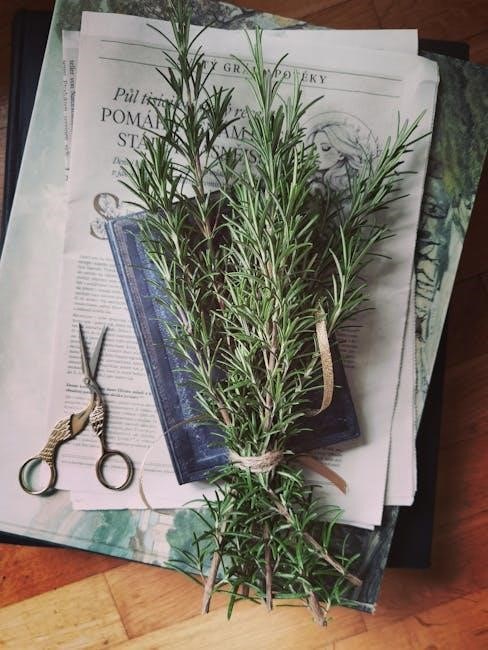
Cunningham’s Encyclopedia of Magical Herbs PDF encourages working with nature, making ethical sourcing paramount. The book doesn’t explicitly detail sourcing, but responsible practice demands consideration for plant populations and ecosystems. Over-harvesting threatens vulnerable species, disrupting natural balances.
Prioritize sustainably grown herbs from reputable sources, or cultivate your own. Wildcrafting, if undertaken, requires deep knowledge of plant identification, legal permissions, and minimal impact harvesting techniques. Avoid purchasing from companies that contribute to habitat destruction or exploit workers.
Respecting the spirit of the plant, as Cunningham advocates, extends to ensuring its continued existence. Conscious consumption honors the magical properties detailed within the PDF and supports a harmonious relationship with the natural world.